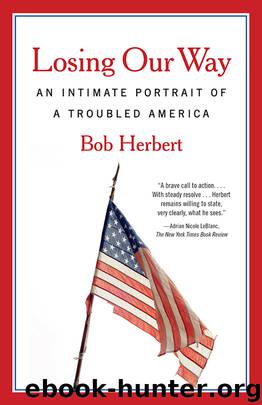
Losing Our Way by Bob Herbert
Author:Bob Herbert [Herbert, Bob]
Language: eng
Format: epub
ISBN: 978-0-385-53589-2
Publisher: Knopf Doubleday Publishing Group
Published: 2014-10-07T04:00:00+00:00
8 Poverty and Public Education
Even young babies growing up in low-income neighborhoods already evidence elevated chronic stress.
—Researchers GARY EVANS, JEANNE BROOKS-GUNN, AND PAMELA KATO KLEBANOV
The warmth generated as Deonne Arrington walked the halls of her school was extraordinary. At age forty-seven, and with her arms outstretched for a hug or to give a reassuring squeeze on a pair of young shoulders, she seemed more like the perfect mom than a principal. Somehow she knew the names of nearly all of the four hundred students at Lincoln Elementary, a prekindergarten-to-fifth-grade school in the tough East Liberty neighborhood of Pittsburgh. I walked beside her, taking notes, on an afternoon in February 2013. Lincoln was one of several struggling schools that I was visiting to get a better sense of what was happening beneath the veneer of the testing phenomenon.
Arrington had a smile and a high five or an encouraging word for every student she encountered. Some of them were tiny. “Are you going to make the honor roll this month?” she would ask. A child would smile shyly and nod. “That would really put a smile on my face,” Arrington would say.
I chuckled. When I was in school, you’d try to flee if you saw the principal coming. With Arrington, the opposite was the case. The kids seemed irresistibly drawn to her. “Miss Arrington! Miss Arrington! Hi! We’re making cupcakes. Do you want me to make one for you?” Smaller children would sometimes wrap their arms around her legs as if they would never let go.
“What are you reading?” Arrington would ask. “How’s your mom doing?”
Watching Arrington in action, I marveled at her ability to remain upbeat. There was almost an idyllic quality to her interaction with the children, which contrasted with the troubling reality of many of their young lives. It would have been easy for a casual onlooker, walking the brightly lit halls gaily decorated with children’s artworks, to get a wrong impression. The backgrounds of some of the children, many of them, were hellish.
“Ours is a high-impact school,” said Arrington, “which means that more than 90 percent of our students are impoverished. There’s a lot of stress and deprivation that they have to deal with, and that has an impact on their schoolwork.”
Ninety-eight percent of Lincoln’s students were African American. Two percent were white. The combination of concentrated poverty and racial isolation is almost always toxic when it comes to education. But the ever-expanding crowd of corporate-style reformers has shown no interest in reducing the isolation of black and Latino students. Segregation in public schools, fed by housing and income patterns, is on the rise, and that increase has been exacerbated by the expansion of charter schools, which—for all their professed concern about achievement gaps and disappointing outcomes—tend to be even more rigidly segregated than traditional public schools. Ashira Mayers, a seventh-grade student at an all-black charter school in Brooklyn, told the New York Times, “We will sometimes talk about why don’t we have any white kids? We wonder what their schools are like.
Download
This site does not store any files on its server. We only index and link to content provided by other sites. Please contact the content providers to delete copyright contents if any and email us, we'll remove relevant links or contents immediately.
| Anthropology | Archaeology |
| Philosophy | Politics & Government |
| Social Sciences | Sociology |
| Women's Studies |
The Secret History by Donna Tartt(19027)
The Social Justice Warrior Handbook by Lisa De Pasquale(12182)
Thirteen Reasons Why by Jay Asher(8883)
This Is How You Lose Her by Junot Diaz(6872)
Weapons of Math Destruction by Cathy O'Neil(6260)
Zero to One by Peter Thiel(5782)
Beartown by Fredrik Backman(5734)
The Myth of the Strong Leader by Archie Brown(5491)
The Fire Next Time by James Baldwin(5423)
How Democracies Die by Steven Levitsky & Daniel Ziblatt(5211)
Promise Me, Dad by Joe Biden(5139)
Stone's Rules by Roger Stone(5078)
A Higher Loyalty: Truth, Lies, and Leadership by James Comey(4946)
100 Deadly Skills by Clint Emerson(4911)
Rise and Kill First by Ronen Bergman(4775)
Secrecy World by Jake Bernstein(4738)
The David Icke Guide to the Global Conspiracy (and how to end it) by David Icke(4696)
The Farm by Tom Rob Smith(4500)
The Doomsday Machine by Daniel Ellsberg(4481)
